Can you tell what a Super Tuscan is?
The honest answer?
Almost nobody can.
Let’s start with the first problem:
Is it Supertuscan, Super Tuscan, Super-Tuscan… or what?
Already confusing, right? Good. Because that’s exactly the point.

So… what the hell is a Super Tuscan?
Trying to define a Super Tuscan is like trying to define rock music.
Everyone has an opinion. Nobody fully agrees.
There’s no single grape.
No single area.
No single rule.
And that’s exactly why they exist.
Super Tuscans were born as a rebellion against the rigid Italian wine laws (DOC and DOCG), which, at the time, were forcing producers into rules that didn’t always make great wine.
So some winemakers said:
“You know what? We’ll just make better wine and deal with the classification later.”
Rock’n’roll.
What’s inside the bottle?
This is where it gets interesting.
Super Tuscans can include:
- Sangiovese (the king of Tuscany)
International grapes:
- Cabernet Sauvignon
- Cabernet Franc
- Merlot
- Petit Verdot
- Syrah
And very often, they come with:
- French oak barrels (barrique)
- more structure
- deeper concentration
- serious aging potential (decades, not years)
Think power, elegance, and attitude.
4 styles of Super Tuscans
Not all Super Tuscans play the same song.
You can roughly divide them into:
-
100% international grapes
→ like Masseto (pure Merlot madness) -
Bordeaux-style blends
→ like Sassicaia or Ornellaia -
Sangiovese + international blend
→ like Tignanello -
100% Sangiovese (outside DOC rules)
→ like Flaccianello
Different styles. Same philosophy: freedom.
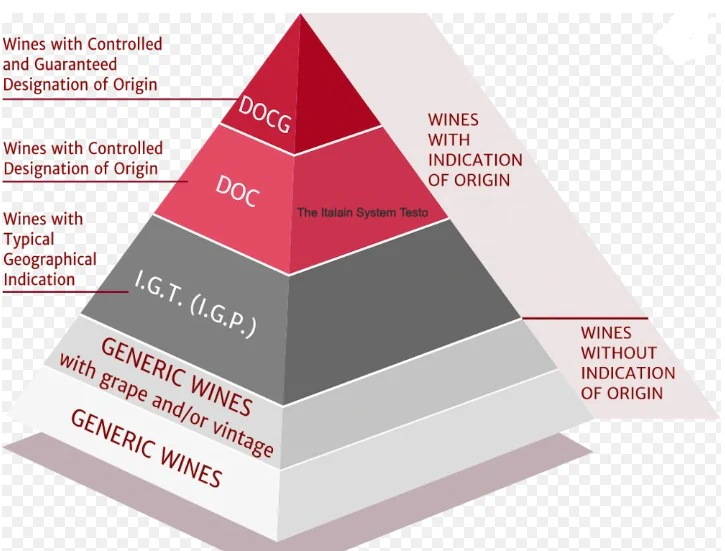
Why are they usually IGT?
Because they broke the rules.
Italian classification goes:
- DOCG (strict rules)
- DOC
- IGT (more freedom)
Super Tuscans didn’t fit the DOC/DOCG system at the time, so they landed in IGT Toscana.
Funny thing?
Some of the best wines in Italy are technically in a “lower” classification.
That tells you everything.
Where it all started
The first real sparks came in the late ‘60s.
- 1968 → Vigorello (San Felice)
- 1971 → Tignanello revolution
But the real legend?
Sassicaia
Born in the 1940s in Bolgheri by Mario Incisa della Rocchetta, inspired by Bordeaux wines.
At first, it wasn’t even sold. Just drunk privately.
Then it hit the market.
And boom—Italy changed forever.
A secret most people don’t know
Blending French grapes in Tuscany is NOT new.
Back in the 1600s, in Carmignano, the Medici family imported Cabernet.
So technically?
The first Super Tuscan might be older than you think.
So what is a Super Tuscan, really?
Not a grape.
Not a place.
Not a law.
It’s an idea.
Freedom to make the best wine possible, without compromises.
And yes… Montepulciano has them too 😉
Everyone talks about Bolgheri.
But we’ve got some serious players here as well.
If you want to take a little trip from Montepulciano to Bordeaux (without leaving Tuscany):
-
Le Stanze – Poliziano
Cabernet Sauvignon & Merlot -
Pietrose – Talosa
100% Merlot, dark, deep, seductive -
Sancta Catharina – Dei
Sangiovese meets Bordeaux in a beautiful way
The birth of Super Tuscans: when great wine refused to follow the rules
Before Super Tuscans existed, Italian wine—especially in Tuscany—was locked inside a very rigid system: the DOC and DOCG regulations.
On paper, those rules were meant to protect quality and tradition.
In reality?
They were often holding great wine back.
The problem with the DOCG system (back then)
Take Chianti, for example.
The official rules required:
- Sangiovese as the base
- White grapes blended in (yes, really)
- strict vineyard and winemaking constraints
- little room for experimentation
So even if a producer had incredible vineyards and vision…
they couldn’t fully express it.
Imagine telling a great chef:
“You must use these ingredients, whether they make the dish better or not.”
That was Tuscany in the ‘60s.
The rebellion begins
A few producers looked at those rules and thought:
“This doesn’t make better wine. It just makes compliant wine.”
So they did something radical.
They stepped outside the system.
They started:
- removing white grapes from blends
- using 100% Sangiovese when it made more sense
- introducing French varieties like Cabernet Sauvignon and Merlot
- aging wine in French barriques instead of large traditional botti
And most importantly…
They focused on quality over classification.
The price of freedom
There was a catch.
If you didn’t follow DOC/DOCG rules, your wine couldn’t be labeled as Chianti or any prestigious denomination.
So these wines—often far superior—were downgraded to simple Vino da Tavola (table wine).
Think about that:
Some of the best wines in Italy…
sold as basic table wine.
But the market noticed.
And the market didn’t care about labels—it cared about what was in the glass.
The first sparks of a revolution
Wines like:
- Tignanello
- Sassicaia
started gaining international attention.
They were:
- richer
- more structured
- more modern
- more aligned with global fine wine standards
Critics loved them. Collectors chased them.
And suddenly…
“Table wine” from Tuscany was competing with Bordeaux.
From rebellion to movement
This wasn’t just a stylistic change.
It was a cultural shift.
Super Tuscans became:
- a statement of independence
- a challenge to the system
- proof that great wine doesn’t come from rules—it comes from vision
Eventually, the system had to adapt.
In 1992, Italy introduced IGT (Indicazione Geografica Tipica)—a category that gave producers more freedom while still recognizing origin.
That’s where most Super Tuscans live today.
What they really represent
Super Tuscans were never just about:
- Cabernet vs Sangiovese
- barrique vs botte
They were about one simple idea:
Breaking the rules when the rules stop making sense.
Final thought
Without the rigidity of the DOCG system,
Super Tuscans might have never been born.
But without the courage to go against it…
they definitely wouldn’t exist.
And that’s why, even today,
every great Super Tuscan carries a bit of rebellion in the glass. 🍷🔥